
Femoroacetabular Impingement – Etiology, Diagnosis, and Treatment of FAI

FAIFemoroacetabular impingement is a pretty hot topic right now.  This week, we have a great guest post from frequent contributor Trevor Winnegge.

Recently, femoroacetabular impingement, or FAI, has been increasingly recognized as a cause of hip pain. While femoroacetabular impingement can be a source of hip pain at any age, this post will focus primarily on the adolescent and young adult.  Femoroacetabular impingement is considered a cause of labral and chondral injuries as well as secondary osteoarthritis of the hip. Emerging evidence suggests that early surgical intervention improves function and perhaps prevents or delays the onset of degenerative changes in the hip joint.[1] I hope to provide a thorough overview of FAI, the signs and symptoms of it, and how to treat FAI in an effort to allow us to play an important role in the management of these patients.

What is Femoroacetabular Impingement?

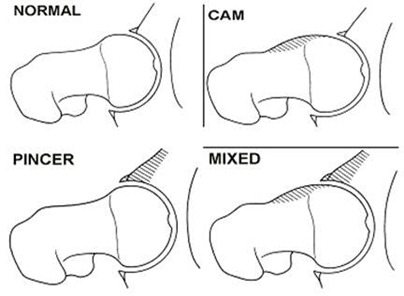
Femoroacetabular impingement occurs when the femoral head and acetabulum rub abnormally, resulting in damage to the articular cartilage and/or the labrum, as well as limited range of motion (ROM). FAI is commonly classified into 3 forms

  1. Cam impingement deformity
  2. Pincer impingement deformity
  3. Mixed impingement deformity resulting in a combination of the two.

These are clearly seen in the following illustration taken from Lavigne et al.[2]:
femoroacetabular impingement

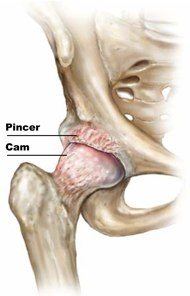
In a Cam impingement, there is an abnormal contour of the femoral head-neck junction, resulting in impingement against the acetabulum, particularly with flexion, internal rotation, or a combination of flexion and internal rotation of the hip.[3] This is better illustrated here in this picture from the Childrens Healthcare of Atlanta[4].

hip cam impingement

Pincer impingement is caused by an acetabular abnormality, usually anterior, resulting in overcoverage of the femoral head. This could be an isolated bony protrusion or it could be a degree of acetabular retroversion. Here the ROM is limited as the femoral head impacts the extended acetabulum which can also lead to labral tears and chondral lesions.[5] This is well illustrated in the following picture, also from the Childrens Healthcare of Atlanta.[6]

hip pincer impingement

A Mixed type of femoroacetabular impingement is a combination of both Cam and Pincer impingement deformities. It is important to note that both Cam and Pincer impingement have been associated with progressive joint degeneration.

Etiology of Femoroacetabular Impingement

Femoroacetabular impingement is linked to childhood hip disorders such as Legg-Calve-Perthes Disease, Slipped Capitol Femoral Epiphysis, hip dysplasia, septic hip, and prior fractures of the pelvis or femur. [7] Despite those correlations, the majority of FAI cases are of unclear etiology[8]. It is theorized that physeal stresses placed on the femoral head and/or acetabulum during development may play a key role in the onset of FAI. Activities such as gymnastics, dancing, and rigorous sports during the development process are potential sources of FAI.

Diagnosis of Femoroacetabular Impingement
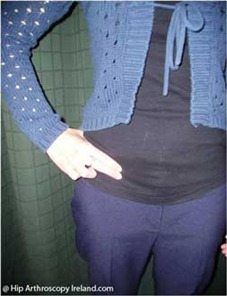
hip c signDiagnosing femoracetabular impingement starts with a good subjective history. Patients will often complain of hip or groin pain- laterally, anterior or posterior. This pain is often acute during a sporting activity or will be insidious onset after prolonged exertion. Patients with FAI are often quite capable of completing their daily tasks, but have difficulty with high demand sports/activities. Typically there is no rest or night pain. When asked to pinpoint their pain, they will often demonstrate a “C” sign, described by Byrd[9], and seen below in this picture from hiparthroscopy-Ireland.com[10].

Patients will report a lack of ROM of the hip, which in an adolescent patient is often described as a functional deficit such as “I can’t do a split anymore” or “I can’t move my leg in this position”. When asked about their activity level, these patients will often be involved in a high level sport or activity such as dance, gymnastics, lacrosse, hockey, tennis, baseball, and football. Objectively, there will be a loss of ROM, particularly hip flexion, IR and adduction. Joint capsule hypomobility may or may not be present. A positive hip impingement sign will often be present, which is flexion, adduction and IR of the hip in a combined movement[11].

Diagnostic Imaging in Femoroacetabular Impingement

Plain film X-rays are most commonly used to view the bony changes of the femoral head and acetabulum. MRI or MR-arthrograms are useful in diagnosing secondary injuries such as chondral lesions and labral tears.

Differential Diagnosis for Femoroacetabular Impingement

Often times, patients with femoroacetabular impingement get misdiagnosed early on and are treated for a variety of diagnoses such as back pain, hip pain, groin pain, bursitis, piriformis syndrome, tendonitis of iliopsoas, groin strain, apophysitis, and “growing pains”[12].

Treatment of Femoroacetabular Impingement

While surgical management of the femoroacetabular impingement remains the an option for treatment, non-operative care can sometimes be successful. Unfortunately, we can not alter the bony changes, but we can normalize soft tissue length, joint capsule mobility, strength and educate on joint preservation techniques. Think of it as treating a patient with a large bone spur in the shoulder that has subacromial impingement. Treatment can be successful despite the bony changes, if the objective deficits are addressed. The success of conservative care for FAI is largely dependent on the patients willingness to modify their sport/activity and become less active in impact sports.

For most adolescents and young adults, this is not an option. While most patients will try conservative care first, often they are unable to fully participate in their sport/activity and seek further management of their FAI. Surgical management can be done open or via the arthroscope, which is becoming the more commonly used method due to its lower level of invasiveness. Surgical treatment is aimed at addressing the secondary injuries such as the chondral lesions and labral tears. The surgeon will address the primary cause of the femoracetabular impingement, typically performing a decompression/osteoplasty.[13] Post-operative rehabilitation is dependent on the procedure performed (labral debridement vs repair; open vs arthroscopy, etc). Typically, recovery from most FAI surgical procedures is 3-4 months, with the expectation that the patient is then able to return to full, unrestricted activity and sport.

In conclusion, I think it is important that we are aware of femoroacetabular impingement and the presentation of FAI. Given it is often misdiagnosed early on, we can play an integral role in the management of these patients. Early diagnosis and treatment is critical for long term health of the hip joint and to allow the patient a lifetime of active living.


  • [1] Roy D. Arthroscopy of the hip in children and adolescents. JChild orthop. 2009 April; 3(2):89-100.
  • [2] www.hipfai.com
  • [3] Leunig M, et al. The Concept of Femoroacetabular Impingement: Current Status and Future Perspectives.
  • Clin Orthop Relat Res. 2009 March; 46793): 616-622.
  • [4] http://www.choa.org/child-health-glossary/f/fe/femoroacetabular-impingement
  • [5] Leunig M, et al. The Concept of Femoroacetabular Impingement: Current Status and Future Perspectives.
  • Clin Orthop Relat Res. 2009 March; 46793): 616-622.
  • [6] http://www.choa.org/child-health-glossary/f/fe/femoroacetabular-impingement
  • [7] Leunig M, et al. The Concept of Femoroacetabular Impingement: Current Status and Future Perspectives.
  • Clin Orthop Relat Res. 2009 March; 46793): 616-622.
  • [8] Philippon M, et al. Femoroacetabular impingement in 45 professional athletes: associated pathologies and return to sport following arthroscopic decompression. Knee Surg Sports Traumatol Arthrosc. 2007 July; 1597):908-914.
  • [9] Byrd JW (2005) Operative hip arthroscopy, 2nd edn. Springer, Berlin.
  • [10] www.hiparthroscopy-Ireland.com
  • [11] Dooley P. Femoroacetabular impingement syndrome. Can Fam Physician. 2008 January; 5491):42-47.
  • [12] www.hipfai.com
  • [13] Ilizaliturri V. Complications of Arthroscopic Femoroacetabular Impingement Treatment: A Review. Clin Orthop Relat Res. 2009 March; 467 (3): 760-768.

Trevor has been practicing PT for over 10 years. He graduated from Northeastern University with a bachelors in PT and a master of science degree. He also graduated from Temple University with a Doctor of physical therapy degree. He is a board certified specialist in orthopedics and also a certified strength and conditioning specialist. He is adjunct faculty at Northeastern University, teaching courses in orthopedics and differential diagnosis. He is currently the Clinical Coordinator of Rehabilitation at Sturdy Orthopedics and Sports Medicine Associates in Attleboro MA.

Mike’s Thoughts

Trevor, great post as always.  Femoroacetabular impingement is a diagnosis that we are seeing more of each year, likely from a combination better awareness and diagnostics.  Unfortunately, we have all probably all missed some patients that were having early symptoms of FAI and treating them for the wrong reasons, like groin pain!  Personally, I have seen “groin strains,” “hip flexor strains,” and even “oblique strains” that were probably actually coming from the hip joint.  Bottom line to me, if the symptoms and exam are not adding up or the person is not responding to treatments be sure to clear the hip of FAI symptoms to make sure you are not missing femoroacetabular impingement.

In regard to treatment, there really are some similarities to the shoulder that can help take the “fear of the unknown” out of treating the hip.  For example, a pincer lesion is really pretty similar to hooked acromion.  How do we treat that in the shoulder?  Open up the subacromial space with retraction and posterior tilt of the shoulder.  How would we treat the hip?  Open up the joint with posterior pelvic tilting, and gaining mobility of the groins and hip flexors.  Just one quick example but enough to get our brains rolling!

Learn More From Mike - FREE Newsletter!

Subscribe to my free newsletter now to learn a ton more and received 3 free gifts: A 36-page eBook "Solving the Patellofemoral Mystery," a 30-minute webinar "What's New in 2010," and my updated accelerated rehab protocol following ACL reconstruction.  I hate spam as much as you, your email is never sold or shared!

Other Related Articles:

61 Responses to “Femoroacetabular Impingement – Etiology, Diagnosis, and Treatment of FAI”

  1. Great post, Trevor (and Mike). This is something we are seeing more and more with the young athletes we train.

    One thing I’d add is that in those we’ve encountered, it is not at all uncommon for them to present with back period for an extended period of time, but ZERO hip/groin pain. They get so accustomed to moving at the lumbar spine as a compensation that the initial structural problem can be almost overlooked.

    Outside of catchers, we have quite a few that can be managed conservatively. We tend to focus more on single-leg work, elevated deadlift variations, pull-throughs, glute-hams, etc.

    Not uncommon to see this alongside the “sports hernia” diagnosis (especially right side), which makes exercise selection even more limited. Aren’t hips fun?

    Great work.

    • Eric you are right on about FAI being associated with sports hernia. Here is a link to an article on a study just presented at AAOS. http://www.sciencedaily.com/releases/2011/02/110219165223.htm

    • Good thoughts Eric, definitely true. My bet, and just assuming here, is that your clientele is on the younger side. I’ve notice that symptoms of FAI tend to have a vague presentation of hip, groin, thigh, back, abdominal, etc pain and can be managed conservatively, at least initially. It seems like many people are anatomically prone to FAI and then do some activity or sport that just feeds into it.

      Unfortunately, over time, the vagueness goes away and they become less responsive to conservative care.

      What we need to figure out is wether or not we can slow or reverse this. We are getting there but still have a ways to go with hips!

      • Sergio Velasquez from Medellin Colombia Reply March 11, 2011 at 11:24 am

        Thanks a lot.
        Article very important in our orthopaedic and sport injuries rehabilitation about common errors in dierential diagnosis in hip examination in our phyiscal therapy field
        Excuse for my english
        regards
        Sergio Velasquez
        Medellin . Colombia

    • Hi Eric,

      Thanks for your comments on conservative management.

      I was diagnosed at 27 with FAI. I only play sport at a social level so surgery was not recommended by my doctor because I am still functionally competitive. I still want to train hard like everyone else but when I do the squats, deadlifts and Olympic Lifting, it will lead to all the symptoms described by other people in this thread. My question to you is can you share more exercises for conservative management? The elevated deadlifts have helped me a lot so far. I also try barbell hip extensions to replace the squat. Nothing feels as good as a full deep squat but my back can only support them once every month. Even then it’s probably foolish to try and keep incorporating them. Strength coaches have often complemented my lifting technque, that is, until they see me attempt a full squat. Then they are lost for words to correct the technique because nothing seems to change my limited ROM.

      To keep someone progressing on a strength program one must admit it’s hard to do without incorporating the major compound lifts of deadlift, squat, or Olympic lifts (i’m not saying impossible, but for someone with limited access to expertise, and a tendancy to just want to get on with playing the sport, it’s hard to construct a program around the FAI restrictions).

      Any advice you can provide about conservative management while persuing a strengthening program would be much appreciated.

  2. Brent Van Gemert Reply March 7, 2011 at 9:35 pm

    I agree with Mike and Eric in regards to clinical presentation. We recently had 2 high school kids with a hip debridement secondary FAI. One ended up with a labral debridement and the other a football player with a cam lesion. Both tried conservative routes with vague hip pain which never resolved. As mike said “the vagueness goes away” and they become less responsive. Unfortunately I may have another on the way but MRI pending and she’s only 15. One upside is I’ve found with the surgery in the right circumstances these kids responded really well and really quickly, and we were holding them back a bit to not over do it.

  3. Trevor Winnegge PT,DPT,MS,OCS,CSCS Reply March 8, 2011 at 6:13 am

    Thanks Eric. I also believe that a lot of these kids can be treated conservatively. Upon examination almost all of them have muscle length restrictions, weakness of core/gluts/glut med/hip rotators. Most high school conditioning programs are insufficient in my opinion, and many parents can’t afford to send their kids to a sports conditioning program. As a result, we see kids with FAI, with extremely weak lower abs, core and hips(which is why I believe there is such a strong correlation between FAI and sports hernia). Many of these kids are able to compete in their sports early on in the rehab process. Therapy works on the impairments, and they ultimately improve. Frankly, who wouldnt, after going through a month of stretching, soft tissue, and targeted strengthening. This is when their vague complaints of pain go away, such as back pain, vague hip pain. Once they resume dance, gymnastics, football etc, the large compression forces with impact flare up the FAI all over again. Now they return to the doctor/clinic with more pinpoint hip pain. This results in eventual diagnosis of FAI but in reality they could’ve been diagnosed 6 months to a year earlier, but we missed it! To speak on Brents point, I agree that these young athletes post operatively progress very well-the power of youth!!!! They regain the ROM quickly and then it is a matter of strengthening their deficits. Ultimately we have to remind them that they did have hip surgery, requiring shaving of the bone and it takes a good 3-4 months to heal. High school athletes are always chomping at the bit to return to sport quickly. They feel great, no pain, and do not understand why they have to wait. Thus the need for education on expected outcomes early and often to both patient and parent to ensure compliance with program and a safe return to sports when allowed!

  4. Brent Van Gemert Reply March 8, 2011 at 8:35 am

    Well put all around Trevor I think you hit the nail on the head…education is key and totally agree with the deficits you find in these kids. Thanks.

  5. Trevor, great post on something a lot of us probably miss. A couple questions, any idea if this ever presents bilaterally? Also, have you read anything that would lead you to think that this would more likely happen in one hip than the other?

    Thanks,

    Nick

  6. Trevor Winnegge PT,DPT,MS,OCS,CSCS Reply March 8, 2011 at 10:34 am

    Nick,
    There was a study by Allen et al, published in Journal of Bone and Joint Surgery (Br) in 2009 that showed 88% of patients with a symptomatic hip and cam deformity demonstrated a cam deformity on the contralateral asymptomatic hip. 42% had a pincer deformity on contralateral side. So it definitely occurs often bilaterally. Most young athletes with bilateral symptoms will stage their hip scopes 4-6 weeks apart. As for right vs left or dominant vs nondominant legs, I did not come across any literature regarding this. The theory as to why FAI develops is because of a high load placed on growing bones. Given that most sports require equal force distribution through both legs, it is easy to see why the incidence of bilateral FAI occurs. Running and jumping stressed both legs equally. My thoughts on single limb FAI are that if you have a dancer that may land primarily on one leg only, they may be at a greater risk of developing unilateral FAI. This is not backed by research and is just my thoughts.

  7. Trevor, great stuff. In addition to this:

    “The theory as to why FAI develops is because of a high load placed on growing bones.”

    I’d also say that it has to do with today’s kids being more and more sedentary outside of athletic participation – and meanwhile, they compete more and more often. More physically unprepared body + more athletic participation = structural changes we just haven’t seen on this level in the past.

    One thing I’d add is that in all the kids that have come our way with FAI, not a single one of them hasn’t has short, dense, fibrotic, and all-around nasty adductors. It’s not all that “socially acceptable” to get in and treat soft tissue right up by the pubis attachments in a 15-year-old kid, but it’s probably what could benefit them the most in terms of immediate symptomatic relief and functional improvements. Sitting = hip adduction, and kids sure do a lot of sitting nowadays. Maybe if they played tag and actually changed directions when they were 7-10 year-old instead of just living on their X-Box, our lives would be a lot easier!

    • Yes, Eric, I agree. Kids today don’t go out and play and have fun. It is structured sport or xbox. And many of these kids would benefit from adductor soft tissue work. There is no way I am going to do that on a 15 year old girl though. I think it would give good symptomatic relief if I could do it. The question is, is that adductor like that as a guarding mechanism due to the hip pain and FAI??? My guess is yes, and if we did that soft tissue the relief would be temporary.

  8. Kyle True, D.C. M.S. Reply March 10, 2011 at 3:31 pm

    Great read and definitely a more commonly occurring problem. I see quite a bit of adductor length/soft tissue shortening when comparing a patient with suspected FAI as well as a dysfunction in the Glute Med when addressing pelvic stability/imbalances. A good functional screen is always very helpful in addressing FAI.

  9. Trevor and Mike-great stuff. We see a good number of these cases as well since the majority of our athletes are hockey players. As Eric mentioned, most have terrible soft-tissue quality around the hip.

    The Slipped Capitol Femoral Epiphysis mechanism probably holds extra weight amongst hockey goalies, who grow up dropping to their knees in an almost uncontrolled free fall at ages when they surely don’t have the muscular development to control the motion.

    Given the magnitude of these surgeries, we try to focus on conservative approaches. Using single-leg work gives the hips more degrees of freedom, but keeping the athlete above their hip flexion end-range also helps ensure that we’re not getting compensatory lumbar movement.

    Great article!

  10. We are seeing more patients in our clinic age 30 -45 undergoing hip arthroscopy/labral repairs. One in particular is very interested in returning to Yoga, now has 5/5 strength t/o , but I have some concerns re: the extreme end ranges that some positions require, especially in light of the labral repair. Thoughts?

    • Lisa,
      Your patient should achieve all ranges of motion of the hip, especially if during the labral repair, the FAI was addressed. We tell our patients pain is their guide, and ease their way back into those extreme positions slowly. Eventually they should be able to do yoga unrestricted.

  11. Mike,
    Great article and great discussion. We have been getting some relief for our athletes using some of Brian Mulligans techniques. They are labor intensive, but can be very effective. They don’t solve the problem, but they can certainly relieve some symptoms and change the threshold enough to get an athlete back on the field.

    Kevin, I am very interested in the Slipped Capitol Femoral Eppiphysis mechanism. It is the first I have heard of it.(I’m just a strength coach). Is their a resource that might explain it in depth.

    Lisa, Hip impingement has been an issue I have had that went undiagnosed during my college and professional football career. It was very limiting. I am a proponent of yoga and have had nothing but relief from it. I think if the individual is aware that the pain you fell in hip flexion is not helpful, and they can practice yoga with a good practitioner, they should be fine. I have found triangle pose to be a problem, that is manageable with some modifications. Tree pose which involves excessive hip external rotation can also be problematic. Other then that, most poses have been a very effective means of staying fit and healthy without the wear and tear (literally) of change of direction sports.

    Kevin, You are the first I have read that has mentioned the compensation found in the lumbar spine. For years we were all told that lumbar flexion during squatting was due in large part to tight hamstrings(which incidentally never made sense to me) I have theorized that the more likely culprit is hip impingement. The hip reaches end range and the only way to go lower is to posteriorly tilt the pelvis in order to create more space for the lesion on the femoral neck.

    I would love to sit down and discuss this more. There are so many questions. I need more answers!

  12. …..I might also add, that athletes that coaches hate because they are not “knee benders”, I have generally found to have a high level of impingement. They are not just “lazy”.

    Many athletes feel better and gain hip mobility with rest and controlled exercise. They generally perform well in the first couple of weeks of training camp and then fall off as inflammation increases and range becomes more limited….

    OK, I better stop.

  13. Jeff-In reverse order…

    Great point about not being “knee benders”. Because of my history working with hockey players on the ice, it seems that most coaches want their players to skate with the “ideal” stride. I think FAI is one illustration of why some players may opt for a different pattern.

    Lumbar compensation, in some plane, is almost inevitable when people reach their hip flexion ROM, especially in bilateral lower body exercises. The only difference between FAI athletes and “normal” athletes is that FAI athletes will hit that hip flexion end range sooner, in at least one hip. If it’s a unilateral problem, you’ll likely see one hip drop below the other during squatting. That’s why I like single-leg work so much for these athletes-it gives the spine options as to which plane to move (namely that lateral flexion becomes more available) and lessens the compression load. This way, if an athlete fails to stop at THEIR end range (which they need to be educated on), they’re in a less damaging environment.

    The Slipped Capitol Femoral Epiphysis involves some, typically blunt, force that causes a shift in the growth plate at the femoral head/neck junction, which negates the head/neck offset (at least this is the theory). I’ve heard this attributed to things that kids naturally do like jumping out of trees, falling while playing on the playground, or repetitively free falling to your knees while learning how to play goalie! Now, with no femoral head/neck offset, when the femoral head recentrates in the acetabulum, hip flexion will be limited and it’s likely that the repetitive attempts to push hip flexion past the newly found limits will cause some accumulated trauma locally, which (in my opinion) could lead to additional bone growth and therefore an additional exacerbation of the problem. I know that’s long-winded; I hope it all makes sense. Feel free to email me if you have other questions.

  14. Marcello Sarrica PT, DPT, OCS, CSCS Reply March 12, 2011 at 7:36 pm

    I see a number of these FAI’s in long distance runners (females > males)…not sure of the correlation (likely high impact loading). I get good outcomes with Mulligan’s Hip MWM. I do agree with the poor core stability and hip abductor weakness seen in this population. Try some ART on the hip adductors, easier to maintain modesty while getting results.

    Great Post!!!

    • Marcello,
      I agree Mulligan techniques work well on a hip with FAI that has capsular restrictions. Keep in mind that not all limited hip rom is capsular, a lot is simply the anatomical block due to FAI. Certainly there is a combination of both and MWM will allow some motion to return and help improve symptoms. My experience is that it is only temporary and the symptomatic relief is from that vague hip pain. They are left with that pinpoint pain during activity that eventually leads them to a choice of surgery or stop playing sport.

    • As for the ART on the adductors, you can maintain modesty for belly down to insertion of the adductors. However, I think working up near the origin on the pubis is way too uncomfortable an area to be working on in a young kid. Uncomfortable for me as the therapist and them as the patient. I personally do not do any soft tissue in that region.

  15. Thomas PT,DO (european) Reply March 13, 2011 at 4:33 pm

    If we look at the etiology behind FAI you would think that long standing biomechanic changes could be the cause behind this compression and thus the changes seen in the bone.
    Could we catch this before it made irreversible damage and had to be dealt with surgically.

    cheers

    • Thomas, as we learn more about FAI and recognize that it is commonly misdiagnosed, we may be able to prevent this from getting out of hand, but I do see a lot of people that are anatomically predisposed to this and tten just get unlucky with their selection of sport and activity, I.e. Hockey etc.

  16. Great post thus far everyone! I’d just like to add in the diagnosis part to Trevor’s post:
    FABER (sacroiliac jt) – Flexion, Abduction, External Rotation.
    FADIR (FAI) – Flexion, Adduction, Internal Rotation (Just trying to keep it simple. Once you get good manual skills on this, you can feel a bony block and very limited range of motion)

    You’ll be surprised how FAI affects patient greatly! I’ve had a Women’s Basketball player with LBP, and coaches we’re trying to get the athlete in deep defensive squat, sure enough she couldn’t do it due to structure. Also, a track & field athlete had chronic L.hamstring strain, the TF athlete was positive for FADIR and imaging…..speaking of imaging with our orthopaedic doctors, use either MRA or 3T at times. What’s everyone thoughts on 3T? better? more expensive?

  17. Mike,
    I’m interested in what you think might make them anatomically predisposed to FAI. I have theories, but I had the The Slipped Capitol Femoral Epiphysis theory laughed at two years ago, and I’m a bit sensitive! My “theory” is that long femurs, and tall ilium may be precursors as well as a lack of lumbar curve….they seem to be common in a number of the athletes we see with FAI symptoms. Could the corresponding lack of glute function and overactive hamstrings that comes with these issues lead to anterior glide of the femoral head and thus a greater likelihood of lesions being generated on the neck? Could the overactive hamstring indirectly cause a shift of the epiphyseal plate?

    Can we prevent this? Maybe we can give them more coffee at younger ages to stunt their growth! That being said, is the only way to keep them from reaching their breaking point, screening them at a young age and keeping them out of extreme flexed positions? Getting glute activation as a mandate to physical education classes? Bret Contreras, where are you?

  18. Great topic. I think a key point here is that FAI is a structural (bony) issue. As always, an early and proper diagnosis is key. I haven’t seen much success with jt. mob. due to the fact that FAI is not a capsular issue. There may be symptom relief with mobs. and soft tissue work, but it is not addressing the underlying issue. Emphasis on movement quality (avoidance of femoral anterior glide) and neuromuscular retraining should be at the forefront of treatment. Soft tissue work and corrective exercises (i.e. core/glute. strength) are always going to help, however focusing on avoidance of painful postures and ranges of motion is crucial. For example, if a patient has pain > 90 degrees of hip flexion, then that is it!! That is not going to improve due to the structural nature of the diagnosis (assess end-feel). Therefore, modification of seat height (sit on books to raise up) to avoid improper hip angle is important to avoid sitting in “impinged” position all day. A common complaint is standing following prolonged sitting. In addition, avoiding hip flexion > 90 degrees in the gym (in the above example) is crucial. Note where the motion is coming from with a squat and you will see excessive lumbar flexion to avoid impingement. This may protect the hip, but will clearly lead to other problems. Arthrogram is the best dx. tool and finding an MD who will help in proper diagnosis (and not just dx. as hip flexor strain) also helps paint the picture for the patient.

    • Eric-i agree 100%, and this was my motivation behind this post. I know I have, and I am sure other practitioners have treated some of the impairments, whether it is soft tissue, weakness, capsule, etc. Sometimes, these kids come in without xrays and their pain is so diffuse, you can fall into the trap of treating impairments. Increasing awareness of FAI and getting people to think of this structural abnormality is critical. Early Xrays and intervention is crucial to diagnosing FAI, with arthrogram the gold standard for secondary labral or cartilage defects.

    • Eric, good comments. I think often times diagnosis leads us to develop programs based on what they should and sometimes kore importantly Should NOT be doing!

  19. Great stuff as usual Mike (and Trevor). My question:

    What impact, if any, would innominate rotation (anterior or posterior) have on hip flexion and rotation? Is anterior glide associated with this condition?

    • Steve,
      It certainly is not common to see a pelvic inominate rotation in these patients, specifically an adolescent female athlete. Typically they present with weak glutes, and weak core muscles. While performing impact sports this can lead to pelvic rotations. I put this is the categor of secondary findings in these patients. This is correctable with PT and helps improve their vague pain, leaving them with their specific symptoms consistent with FAI. Certainly with weak glutes, tight psoas, they may be more prone to an anterior rotation, although I have seen both clinically. A pelvic rotation can lead to a perceived lack of hip rom as well as hamstring length. When you correct rotation, and there is still deficit, suspect anatomical changes, like FAI.

  20. Mike-
    Thanks for posting this. I am not a credentialed therapist or medical person but a patient who had atheltic pubalgia (right side) and FAI in both hips. I had one done in June 2010 and one December 2010. I am doing great and workin with a great trainer named John Izzo in CT.

    My comments are about how pleased I am to see this coming to the forefront. If FAI is dx’d quickly it is an easy fix. However, many of us get bounced from doc to doc (11 myself…) because our symptoms are so diffuse and many look lumbar first. In fact in my 20′s they gave me a laminectomy because the back/leg pain was so great. No effect and got better with pool work and functioned as a boxer for another 17 years with limited ROM…but just thought I was always tight.
    **Doc says I never had a bad back (as they found nothing, but it was FAI and the leg pain was from a tremendously tight psoas that pulled me into ATP.
    When i was 40 it all happened again…but worst…..Same thing….spinal MRI’s, SI joint injections….11 total docs of all kinds….Nada for dx other than SI Joint dysfunction. It was not until my testicle hurt so bad (right sided) that Dr. Meyers dx’d atheltic pubalgia. It was here he discovered the torn labrums. Within 5 minutes of having a frog position xray at UMASS they told me i had FAI. Upon getting an arthogram it was discovered i had calcium in my adductor longus and pectineus, the orbutor externus (sp?) and a bone spur on my trochanter.

    While awaiting a proper diagnosis I tore my MCL, Meniscus, had plantar fasciatis as well as the tightest quads and psoas in the world.

    My point is that without an early dx the body will compensate the best it knows how. I had a FMS and could not do the stepover without swinging my hip out…Now it is easy and I always just thought I was tight. I can now squat on my heels….I was always on my mid/front of my foot.

    My case was extreme I suppose but i tried many things like NMT, ART, Chiro, PT many times, Sports Massage, Graston, Active Isolated STretching, Robotic Muscular Therapy, a million injections, accupunture, Z Health< Egoscue, CHEK practitioner, FMS, Muscle Activation, Structural Integration, Rolfing and the list goes on and on.

    FAI literally cost me close to 500k with out of pocket expenses over 5 years and 3 years lost wages. No doc could give me a definitve dx and the pain became too great to do anything.

    I applaud you for bringing this up so nobody gets to the point I was at. I know of 4 others who had spine surgery to no avail for this and some even a fusion. One poor lady ended up with a contre coup posterior.

    If anybody has any questions I will be happy to answer. The surgery was a piece of cake even though mine was 4.5 hours due to how thickly muscles my quads/glutes were and how tight I was. The addressing the imbalances is harder than the hip rehab.

    Cheers

    Paul Mazzaferro

    • Paul,

      What was the treatment like once you were finally diagnosed with FAI? What exactly did they do in your surgery; just bone shaving or other issues addressed as well?

      I’ve been considering surgery for my cam impingement, and I have a pretty vast knowledge or prehab stuff because of the people I have around me, but my experience and understanding or the surgical side of things is weak.

      • Lance-

        They addressed the Pincer Lesion first. They then addressed the CAM lesion by reshaping the femoral head. Dr. Greene then repaired the labrum and attached with 2 PEEK anchors. I am 9 months post op on hip #1 and 4 months post op on Hip #2. Best decision I ever made.

  21. Thank you, Trevor. I appreciate you taking the time to reply.

  22. Jake Ellingson, PT, SCS, ATC, CSCS Reply March 25, 2011 at 10:40 am

    Great article! There is definitely a need for more awareness. Just wanted to add that our primary goal for these athletes/patients should be to prevent early onset arthritis (like I now have at the ripe old age of 34) in addition to relieving their current pain. While conservative care is ideal, I agree with Mike based on personal experience that the response to conservative treatment does fade and we should not hesitate or delay in looking towards surgical interventions in order to prevent early onset arthritis.

  23. Hi Mike, Thanks for the article and posting option to to address FAI. I have been diagnosed with Pincer FAI, no arthritis yet but tearing of the labrum is beginning. I noticed this 1 year ago after I started to do more Olympic Style weightlifting. I can not squat past 90 degrees without pain. I have gone through weekly pt, sports massage, ART and even acupuncture to treat it without surgery. But the pain is still there. The only thing that helps is NSAID’s. If quitting Olympic Weightlifting is not an option, do you recommend surgery as my best option?

    • Just don’t push through a pinch, only going to get worse.

    • Unfortunately there is nothing short of surgery that can address a bony impingement. Labrums can be painful because of nerve endings. IMHO and many of the hundreds of sufferers I have spoken to (FAI on Facebook…great source of info) the sooner it is addressed the easier the recovery because the body has not ingrained the muscle imbalances. I was not so lucky and my body had many compensations and when this unraveling happens it is a much harder recovery. Like i said I am not a medical professional but a bilateral surgery patient. Cheers

  24. Thank you for this post.
    I recently had x-rays for hip pain through a chiropractor and the radiology report came back with:
    1. Degenerated L5-S1 disc.
    2. Bilateral femoral acetabular impingement.
    3. Deformity of the femoral heads consistent with slipped capital epiphyses and/or Legg-Perthes disease.

    After reading this article it appears I am classic! My chiro said nothing he could do. Felt the L5_S1 was compensation for the hips. Honest man.

    How do I find a Dr. that specializes in this? I am in Phoenix, AZ area but am willing to travel.

    Ironic. I’m 57 yrs. But learned to swim and walk at the same time. Was competing in breast stroke by age 5, maybe younger. That is quite an exaggerated position to be in for that age. Perhaps related? There is more but I will not bore you.

    Thank you very, very much in advance.

    • Anneal,

      Someone already suggested the Stedman Clinic in Vail, CO. That clinic is excellent but quite expensive, especially if they don’t accept your insurance. A great alternative is Dr. Brian White at Western Orthopaedics down the hill in Denver. Dr. White completed his fellowship under Dr. Phillippon in Vail and performed my FAI operation last year. I had a 3-suture repair and femoroplasty. I had an excellent experience with Dr. White and his team and my recovery went better than I could have hoped.

      I hope this helps, good luck to you.

      -Greg

  25. Seems like the Steadman/Philippon clinic in Vail, CO., might be a good place to start. They seem to have been the “pioneers” in surgical repair of these issues. I’m sure they can refer you to someone in the Phoenix area. I wish you luck. Post back after the surgery, I”m interested in your rehab time.

    • Thanks very much for the lead, Jeff.
      For rehab I’m thinking of Ann and Chris Frederick’s “Stretch to Win” clinic. It was actually by following a small comment Chris made in one of his on-line stretch demo videos that eventually led me to here.
      Thanks again.

  26. I am a 37 year old female, now 9 months out of FAI surgery. It was done arthroscopically and included bone shaving, several sutures to tack down a labrum flapping in the breeze (no other discrete labral tear) and early articular cartilage damage was reported. I am still having pain that is worse than pre- surgery, same location. I also have a lateral femoral cutaneous nerve palsy that has persisted since surgery, and I fear it is permanent damage. My ROM has always been good. At this point I am not sure if I should get more aggressive with rehab, do more resting/waiting, or push for a repeat MRI. Seems like it should have been a lot better by now

  27. Mike, I find it interesting that you say that nothing can be done about the bone deformation. I am scheduled for 2 arthroscopes over the next few weeks. I have cam impingements, which as above, have caused back injuries such as SIJ ligament strain, plus some capsule damage to the left side. The view of my surgeon is to reshape the bone and do whatever repairs necessary in the joints. Do you not believe this is possible? A lot of my injuries have come from as Eric says, incorrect lifting patterns during powerlifting. I had major posterior pelvic tilt which the lower back compensated for. I have played many sports and during my 20′s I developed chronic hamstring problems, I managed to strain them quite often, generally down low in running sports. Do you think FAI is a contributing factor to the hamstring issues I had?

    Cheers,
    Michael.

  28. Hi, I have been looking this up more since being advised to have an scan to check for hip impingement. I have had groin pain starting with what was initially treated as an adductor and stomach muscle strain. I was getting pyhsio for 3 months then started back training and within a few weeks was getting more pain and weakness in the groin area, I then had further treatment on the groin as purely muscle strains and again the pain seemed to get better but after returning to playing football the twisting and turning again started giving me some pain in the groin(all this over a 2 year period). I have only recently been back to the doctor and the specialist has advised I have an MRI with dye injected to check for this impingement as I have in the last 6 months started getting lower back pain which is worse when performing high intensity football training (short sharp turns, etc..). Does this sound like a sure fire case of hip impingement as as recently as last night I attempted to train and afterwards was again feeling more pain and stiffness in lower back and across my groin?

  29. Stuart-It certainly sounds like impingement is a possibility, but there are several associated problems that may warrant consideration. Most immediately, it would benefit you to learn what your available hip flexion range of motion is (at what point during a squatting pattern do your hips start to tuck and your lower back round) and stay above that point during all of your athletic movements (at least whenever possible). I also recommend seeking out a good manual therapist to do some work on your adductors, and to start stretching your glutes. In the hockey players we’ve had that have symptoms like yours, taking these simple steps has gone a long way in decreasing their pain and giving them a better understanding of what contributes to their discomfort and the progression of the injury. Hope this helps.

  30. Hey Stuart, I think, given your symptoms, that you have probably been impinged for some time, if not forever. The acute issues you seem to have would indicate to me that you have a torn labrum. Obviously, I’m not qualified to make that prediction, but given that a few twists and turns irritate you to the degree it does, it seems likely. I like Kevins suggestions and would also be interested in how you respond to the second video on this page.
    http://www.mobilitywod.com/page/4 He has some other videos involving mobilization of the hip laterally, but we haven’t gotten the same positive feedback from our hockey guys on those.

    Keep us posted. I wish you well.

    • Hi Jeff and Kevin,

      Appreciate both your responses and to be perfectly honest I do think my hips have been impinged for well over a year now and may well have been caused by a tear in my adductor and without being checked for impingement when initially getting discomfort has just made the problem worse. I am due to get a MRI scan with dye injected hopefully in the next 3 weeks so I will await the results of that and what the hip specialist recommends. I have always been a very fit person and my legs and stomach area were until these injury problems in perfect condition. Two days now after completing a soccer training sessionand it feels like every muscle in and around my hip and groin area is strained to the point where any movement of my hips gives discomfort, also noticed when doing upper body weights yesterday a clicking sensation in my hip/groin area. I’m just hopefull I am now on the right track to finding out the real cause of the pain. Again thanks for your responses and I will let you know the outcome of my scan in the coming weeks and hopefully the damage isn’t too bad :) .

  31. Hi Mike and others, I am now 10 days post op on my first FAI intervention I guess you could call it. I have had the right side addressed first. I only just today heard from the Physio what exactly was done. I had a femoral and acetabular osteoectomy(spelling)? The ligamentum teres was abrided. I had 3 anchors put in place, I have also had a micro fracture done/repaired? From what the physio has told me, is that I should be ok in 12 weeks, as long as I do the right things to manage the micro fracture above all. I am having the left side done in about 4 days.

    I have had pain in the left side, I never had any pain at all in the right, so I was a little surprised to find they did this much work. It worries me a little as to what they will find on the left side! I hope there is no arthritis in that side. That is my biggest concern.

    I look forward to the point where I can get stuck in active rehabilitation. Doing mostly Quadratus Femoris activation at the moment. Which is frustrating as I am a firm believer in active rehab!

    Cheers,
    Michael.

  32. Pain is a common cause of discomfort and it will be important to now its causes to be able to provide the necessary treatment that it requires.

  33. I’ve been dealing with this for about 1.5 year now.

    Initially I started running about 2.5 years ago without any issues. In 6 months time I ran 2-3 times / week about 8 – 12 km, with occasionally about 15km. As time progressed however I got this vague pain deep near the middle of my hamstrings every time I hit the ground, which sometimes even prevented my from running – my legs just hurted to much and felt too heavy.

    Took a 2 week holiday with lots of mountain hiking, no issues. By the time I got home the leg pain was gone, so I started running again. The leg pain came back. One time I overdid myself and did a 20km run, with as a result that the days after I felt a deep ache near my front left hip/groin area everytime I hit ground or jumped. Several docs and and a left hip MRA later: FAI with CAM on left hip. I stopped running and pain went away in about 4-6 weeks. Never had it again.

    The doc said: go cycling instead if you don’t feel anything while doing that. And so I did. So I went mountainbiking for about 2-3 months. And from a certain moment on I felt low back pain everytime I got on the bike too long, but nothing that would stay or concerned me. On my last MTB ride at a certain moment my right knee started hurting, so much that I could hardly put any pressure on it. Went home, got off the bike, let it rest… it went away and all was fine, except my knee clicked.

    And then the misery started. At one point, about 2-3 weeks after my last ride, when I sat on my desk, my bilateral groin started burning. In 4 days I was nearly cripple – burning, biting pain near anterior psoas, lower back, legs… you name it. I had no idea what was going on – I felt like a cripple. NSAID’s stopped most of it, but it has never been the same. Since then (1.5 years ago) I’ve had huge pain in my butt, lower back pain, SI joint pain, hamstring pain, ITB pain, Quadratus L pain, burning, clicking, unable to sit for over 10 minutes, and this in random order. Some days I would be fine, other days I hardly wanted to get out of bed.

    Had 2 new MRA’s – one for the right as well – and seen 2 hip specialists. Left MRA read the same, right one noted CAM+PINCER and possible small tear. I’ve been told to do PT. 2 times 18 sessions did nothing at all. They don’t even get my symptoms. I don’t have real hip pain, I do not even test positive doing that FADIR thing. But all my muscles are going mad. My leg muscles are tight, short and tensed 24 hours / day and eating all my energy. I can walk up a hill for 20km without issues, but my legs are killing me so tight. I’ve had months of butt pain but I somehow seem to got rid of most of that by doing a certain stretch.

    Recently I found a new doc who believed my symptoms could really be FAI. He gave me a diagnostic injection in both hips at once. While injecting I felt a relief I haven’t got in 2 years. My legs (even up to my shins & calfs), my back, they relaxed immediately. This lasted for about 2 hours. Hours went by and by the end of the day I could not sit for 5 minutes because of the burning back pain. Could hardly walk because of burning leg pain, didn’t have such a flare in months.

    I am now seriously considering surgery. I do not have real hip pain, but my body is going insane at trying to protect me. My cartilage is said to be fine (according to the MRA’s). But this is all so confusing and I really don’t know where else to look.

    I don’t even have the impression the specialists understand it – they all say you need to have hip pain or groin pain when doing sports. I do not even get to sports anymore. Yes I went running 3 times just for a test – no difference, just more tight, and skiing for a week: skiing wasn’t an issue, but in the evening my low back & leg muscles were killing me.

    When he injected me from the side (laterally) I could literally feel this in my shins. I think there’s a huge part of FAI which is not understood clearly, and this is the imbalance it can cause which brings on a ton of muscle & nerve issues.

    I hope my story rings a bell for some people…

    • Hard to offer advice over the internet, though I would say, FAI surgery is more beneficial BEFORE your joint is a mess. The fact that your cartilage looks good is a good sign.

  34. Great discussion. It seems there is a common theme of either lack of movement or poor movement being a contributor and cause of compensations that exacerbate the progression of this condition. It makes me wonder what the potential benefit might be if athletic kids were screened early and regularly with a tool like the FMS to detect movement compensations before they become problematic. I know this isn’t helpful for populations that are dealing with FAI but thought it might make for some interesting discussion on prevention

  35. Now I have been diagnosed with FAI when I was 22, Now 33. My condition was (is) Bilateral. I have had open debriedment on both hips from the head guru Doc who pioneered with this condition. That was 10 years ago. I had two hip scopes last year to help aid the problem also. My condition has been presenting symptoms since as long as I can remember. I have also been active with many sports including football, wrestling, olympic style lifting. Lots of trying to stretch the hips out. Now I have never had range of motion in my hips to begin with, especially with hip flexion, extremely tight hips. I have to admit the most frustrating thing I have dealt with especially with my athletics. Lift funny, run funny, etc. Is it possible that I can gain normal range of motion in the future, Dream come true would be a full depth squat or bring both knees to my chest, Alivate other broblems like hip and back discomfort, or is it likely that normal range of motion is not in my future. I really saw endless possiblities with weightlifting or possible other sports if this condition didnt exist with me. Now main focus is range of motion and stregth training to promote better health now that I am older, not for competition. Has anyone seen extreme tightness gain full range of motion. According to my last Doc, impingement is removed and hips are free, and although ROM has improved, its not that signicant to me. Thanks

  36. Hi! I was wondering what kind of recreational physical activity would you recommend and which activities should be a big nono for people suffering from FAI? Physical activity is a good thing in general, and having good muscles around the hips can only be beneficial, but then again some activities can cause further damage to the hip. So what activities are considered to give the most benefit while at the same time not causing further strain to your hip? I would guess swimming is the best but it is not always an option so what else is there. Thank you!

Trackbacks/Pingbacks

  1. Femoroacetabular Impingement | FAI | Hockey Hip Injuries | KevinNeeld.com - March 16, 2011

    [...] Check it out here >> Femoroacetabular Impingement: Etiology, Diagnosis, and Treatment of FAI [...]

Leave a Reply

*

 Subscribe to Mike's FREE Newsletter and Learn More! 

Notify me of followup comments via e-mail. You can also click here to subscribe without commenting.