

Breathing and Low Back Pain: Is There a Correlation?

Breathing and Low Back PainAs our knowledge of the core and proper lumbopelvic stabilization continues to improve, our understanding of  the diaphragm’s function as a postural muscle continues to improve as well.  We know that as the diaphragm contracts during inspiration, intra-abdominal pressure increases, and lumbar spine stiffness is increased.  During activities the diaphragm acts in coordination with the abdominal muscles, spinal muscles, and pelvic floor to create lumbar stability in all directions.  This is what Stuart McGill refers to as “360 degree stiffness.”

Individuals with Low Back Pain Breathe Differently While Lifting

A recent study publish in JOSPT sought to assess if people with back pain breathe differently when trying to lift an object.  The examiners looked at 32 subjects with chronic, nonspecific low back pain for at least 1 year and compared their breathing performance to a group of 30 healthy controls.

Results of the study revealed that individuals with low back pain lifted objects with 7.2% more air in their lungs than healthy individuals.

Several studies have shown that increases in inspired lung volume correlate to increases in intra-abdominal pressure and subsequent increase in lumbar spine stability.  The results of this study are interesting.  My first thought was that the study was going to show the exact opposite – that individuals with low back pain would have LESS air in their lungs, thus making the diaphragm less effective at stabilizing the lumbar spine.

This could be a protective mechanism in the subjects with low back pain.  They could be breathing this way as a compensatory mechanism to assist the other core musculature that may be performing poorly.  We are unable to know exactly why this difference exists and wether or not it is causative or compensatory.

However, if we dig a little deeper into the results of the study, another interesting finding emerges.  Not only do individuals with low back pain have a different amount of inspired air in their lungs, they also breathe differently during the task.

Individuals with low back pain took a deeper breathe at the start of the lift then rapidly exhaled, while the healthy subjects began with less inspired air but inhaled slightly during the lift.  This perhaps may have a bigger impact on low back pain.  Nevertheless, interesting results that may indicate that educating people how to breathe during lifting tasks is an important part of postural and ergonomic education.

Breathing and Low Back Pain

There are obvious implications for the strength and fitness group, but often overlooked in the rehabilitation community.  Perhaps we need to be educating proper breathing during our exercises and functional movements more during the rehabilitation process as well?  This is something that Eric Cressey and I discuss in our Functional Stability Training of the Core program.  One potential way to incorporate this concept is to use breathing rather than seconds when we perform timed exercises.  What do you think?  How does this study change the way you think about breathing and low back pain?
Like What You Are Reading?  Learn More From Mike!

NEW Inner Circle

Join Mike's Inner Circle and get access to monthly live webinars with Mike and exclusive members only premium content.  Join hundreds of other Inner Circle members today!

     --> Click here for more information on the Inner Circle program


FREE Newsletter

Subscribe to Mike's free newsletter now to learn a ton more and received 3 free gifts: A 36-page eBook "Solving the Patellofemoral Mystery," a 30-minute webinar "What's New in 2010," and my updated accelerated rehab protocol following ACL reconstruction.  I hate spam as much as you, your email is never sold or shared!

Comment on Facebook

comments

9 Responses to “Breathing and Low Back Pain: Is There a Correlation?”

  1. Mike – interesting post. I admittedly used to ignore breathing issues, but since looking for it, it’s amazing how effective correcting breathing dysfunction can be for neck/thoracic pain and low back pain patients.
    If anyone is looking for further information on breathing and lumbopelvic issues, Leon Chaitow has a great post on his blog at http://chaitowschat-leon.blogspot.com/2012/01/breathing-pattern-disorders-and.html

    Thanks for all of the great information.

    Phil

  2. Great post, Mike! I definitely work on breathing with most lumbar pain patients prior to introduction to functional exercise, then incorporate it into exercise. Every thoracic patient, and cervical patients with obvious use of accessory breathing.

  3. “You find what you look for and recognize what you know.” The issue of respiration and stability is no exception. The effect of breathing on lumbar stability has certainly changed how I address LBP. I start with breathing b/c it’s crucial for TL stability, activation of the diaphragm, coordination of the abdominal “canister” – all great things that people will sacrifice to keep from turning blue. :)

  4. I receive JOSPT and always like Mike’s analysis of the articles in there. I believe it’s a compensatory mechanism, but that is solely opinion… I’ve been thinking I need to learn more about breathing to get better outcomes with those I work with.

  5. This is an interesting post. I would say breathing is one of the most powerful interventions for treating a patient with acute pain. There is nothing that taps into the balance of the sympathetic and parasympathetic systems better than breathe work.

    Shea SA, Guz A. Personnalité ventilatoire–an overview. Respir Physiol. 1992
    Mar;87(3):275-91. Review. PubMed PMID: 1604053.

    Is an interesting overview to read before as physical therapists we get into the business of lumping people into categories of normative breathing. Especially when that breathing is simply analyzed by averaging behavior across subjects. Then deriving our ideas of dysfunction based on these deviations from so called norms.

  6. You need to check out “Postural Function of the Diaphragm in Persons with and without Chronic Low Back Pain” Kolar, P et. al. J Orthop Sports Phys Ther. 2011 Dec 21.

  7. Great stuff Mike and so glad to see more practitioners looking into the role of the diaphragm and respiratory function in training and rehabilitation. It is an imperative component in the inhibition and facilitory effects of what we are having our patients do. Evaluation of dysfunction is critical and the article on your site by Hans Lindgren’s “Core Stability from the Inside Out” is a good start.

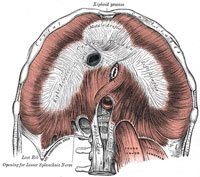
    It is important to recognize that it is NOT just one diaphragm, but that there is a left side and a right side. As the picture above shows, the right central tendon is thicker and bigger, the crura attaches to 3 lumbar vertebrae while the left only attaches to 2, the right side is also anatomically higher than the left and is further supported by the liver. As practitioners, start palpating the anterior lower ribs and compare the left and right sides–the left is often more prominent and flared compared to the internally rotated right side. We can’t just treat it as one unit.

  8. I believe that the breath in this case is part of structural stabilization. Hold the breath gives a potential expansion to the limbs while holding the torso, chest and spine. Check how acrobats breathe while lifting, throwing and catching people in the air. Thanks !

  9. I am so fascinated by the diaphragm and “360″ core stabilization. Is this the reasoning behind inspiring during the eccentric phase of a lift and expiring during the concentric?

Leave a Reply

 Subscribe to Mike's FREE Newsletter and Learn More!